

By Cozy Reading Club. Updated October 25, 2026.
Yes, audiobooks count as reading. For most books, people understand and remember about as much from listening as from reading print. A meta-analysis of 46 studies and 4,687 participants, published in Review of Educational Research, found no reliable difference in comprehension between the two. Print keeps an edge in one case: dense, detail-heavy books where you need to set your own pace and reread. So the short answer is "yes, unless the book needs your eyes."
Key Takeaways
- Research finds no reliable comprehension gap between listening and reading for most books.
- Print does better for dense material, when you need to infer, pause and reread.
- Multitasking hurts comprehension in both formats, and audio a bit more.
- Goodreads counts any book you mark as read, in any format.
Why does this question keep coming back?
Every January, thousands of readers set a Goodreads Reading Challenge goal, and the same thread comes back in reading communities: do audiobooks count? People asking usually aren't looking for data. They want permission. Finishing a book in the car and then wondering if it "really" counts comes with a specific kind of guilt, as if you took a shortcut a real reader wouldn't.
The research gives a clear answer for most books, and a useful exception.
What does the research say about audiobooks vs. reading?
Two studies do most of the work here:
- Rogowsky, Calhoun and Tallal (2016) randomly assigned 91 adults to listen to an audiobook, read the e-text, or do both at once, using the same nonfiction chapter. They found no significant difference in comprehension, either right away or two weeks later (SAGE Open).
- Virginia Clinton-Lisell's meta-analysis pooled 46 studies covering 4,687 participants and found that the gap between reading and listening comprehension was not reliable overall (Review of Educational Research, 2021).
The same meta-analysis found where print keeps an advantage:
- Dense or complex material. When a test asked readers to infer instead of simply remember, people who read at their own pace did better than listeners going at the narrator's speed.
- Multitasking. Comprehension drops for both formats when your attention is split, and it drops more for audio. That's the "I listened to the whole chapter and remember nothing" feeling.
- Study habits. Print makes it easy to underline, flip back and reread a paragraph. Those habits help with detail-heavy books and are clumsier in audio.
When does the format actually matter?
| If the book is... | Audio works great | Print has the edge |
|---|---|---|
| Plot-driven fiction, romance, thriller, most romantasy | ✅ | |
| Full of character voices, with a great narrator | ✅ (often better than print) | |
| Dense nonfiction, philosophy, anything argument-heavy | ✅ | |
| A book you'll want to flip back through or annotate | ✅ | |
| Something for driving, cleaning or walking | ✅ | |
| For a reading challenge, a book club or just for you | ✅ It counts. |
Long romantasy series are a good example. Some of them run past 800 pages, and plenty of readers get through them on walks and commutes. If you're struggling to focus on print lately, audio can also be a way back in: we wrote about that in why you can't focus on reading anymore.
How to get audiobooks for free
Most U.S. public libraries lend audiobooks through Libby, the OverDrive app. All you need is a library card. Waitlists for new releases can be long, so place holds early.
You can drop the guilt
If you finished the book, you read it. Your Goodreads Reading Challenge doesn't ask how the words got into your head, only whether you finished. Somewhere along the way "real reader" turned into a club with a door policy, which is an odd thing to stress about in a hobby that's meant to be fun. Audiobooks count. Log them, and skip the apology in your Goodreads review.
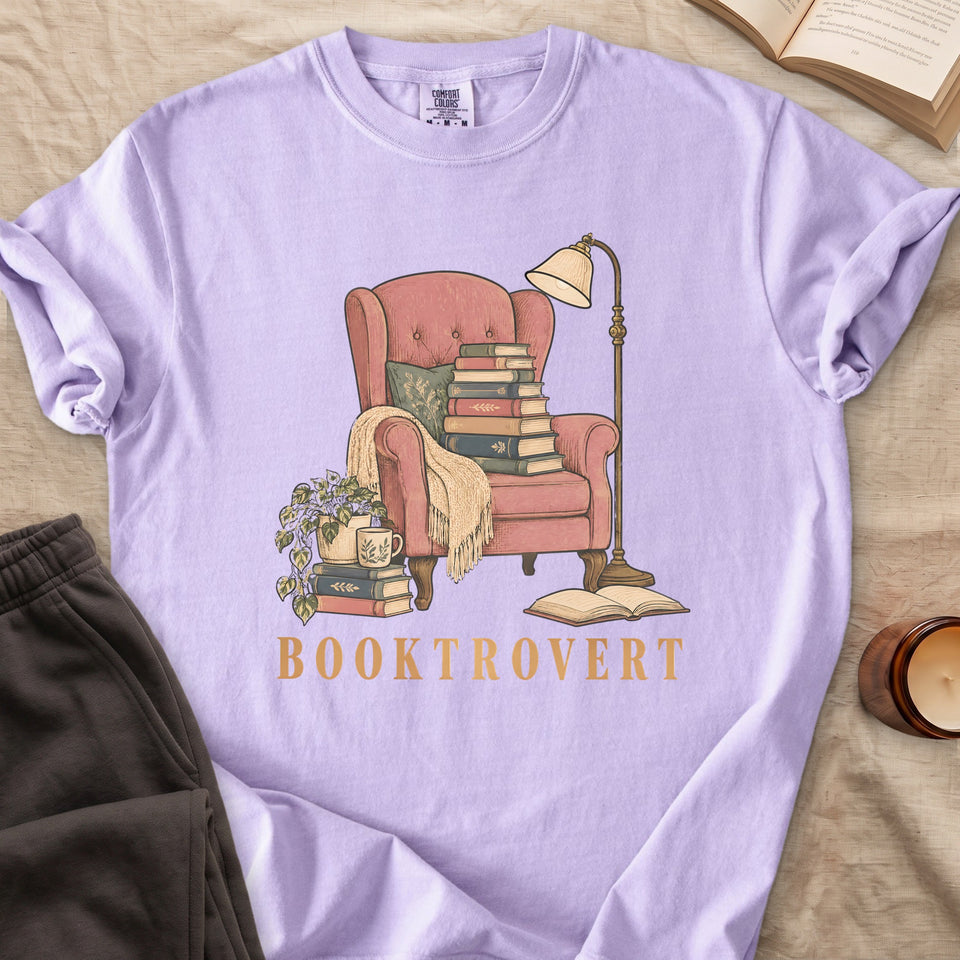
If you've ever wondered mid-audiobook whether you're a real reader, our Booktrovert collection was made for you, with tees like Booktrovert Reading Chair and Reading Is My Escape. All our bookish tees are here too, for listeners and page-turners alike. Buying for an audiobook fan? Our gifts for book lovers guide has a section just for them.
FAQ
Do audiobooks count as reading for a Goodreads Reading Challenge?
Yes. Goodreads counts any book you mark as read, whatever the format, and the research agrees for most books: a meta-analysis of 46 studies found no reliable difference between reading and listening comprehension overall.
Do you retain less from audiobooks than from print?
For most fiction and narrative nonfiction, no. Studies show similar comprehension and memory. The exception is dense material that asks you to infer, where readers who control their pace and can reread tend to do better.
Which books work best as audiobooks?
Plot-driven fiction, romance, thrillers and books with strong character voices and a skilled narrator work as well as print, sometimes better. Dense nonfiction and books you'll want to flip back through are usually better on paper.
Is listening to an audiobook while doing something else still reading?
Yes, but expect to remember less. Split attention lowers comprehension in both formats, and more so in audio. Save complex books for focused listening and keep easy listens for chores.
Why do some readers feel guilty about counting audiobooks?
Mostly because of an unspoken idea that print is the "real" or more virtuous way to read. For most books, the comprehension data doesn't support that ranking. Finishing a book is finishing a book.